
Last updated October 16, 2026
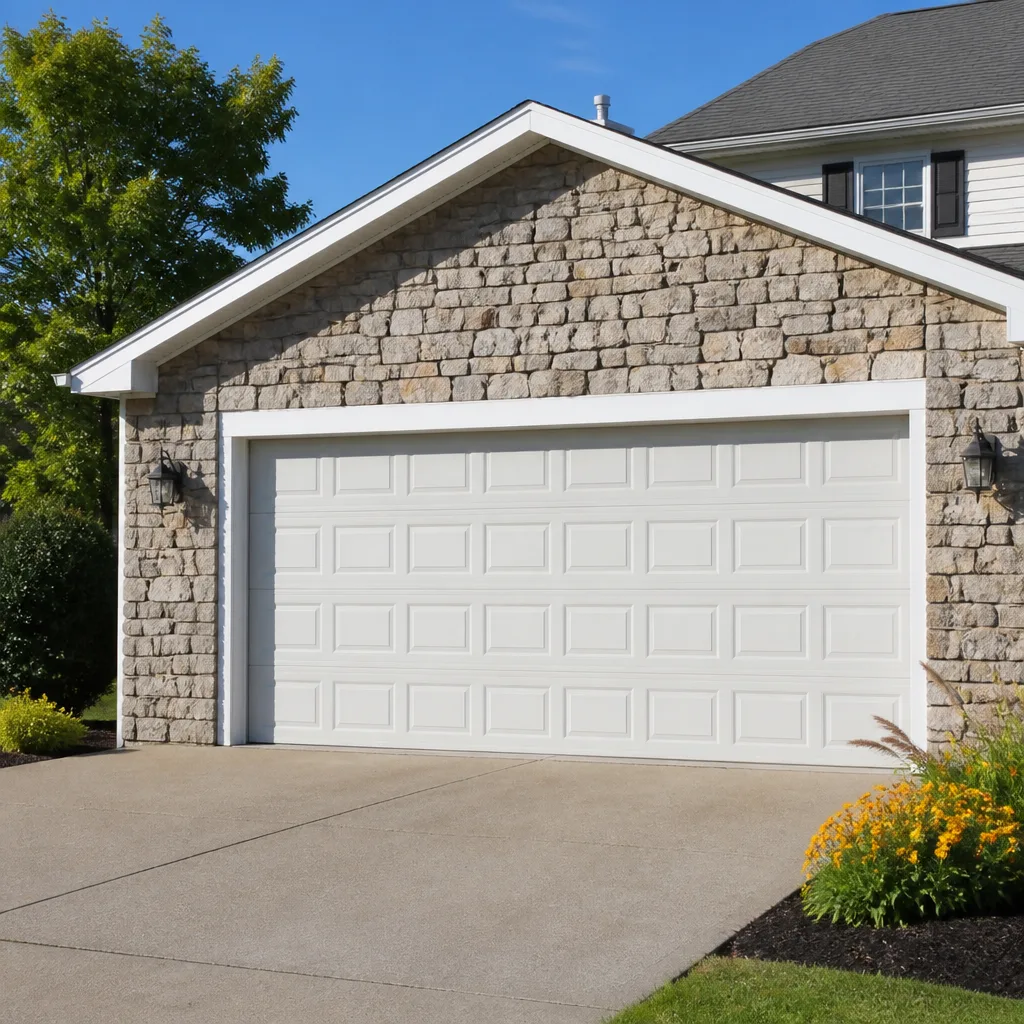 Raised-panel steel
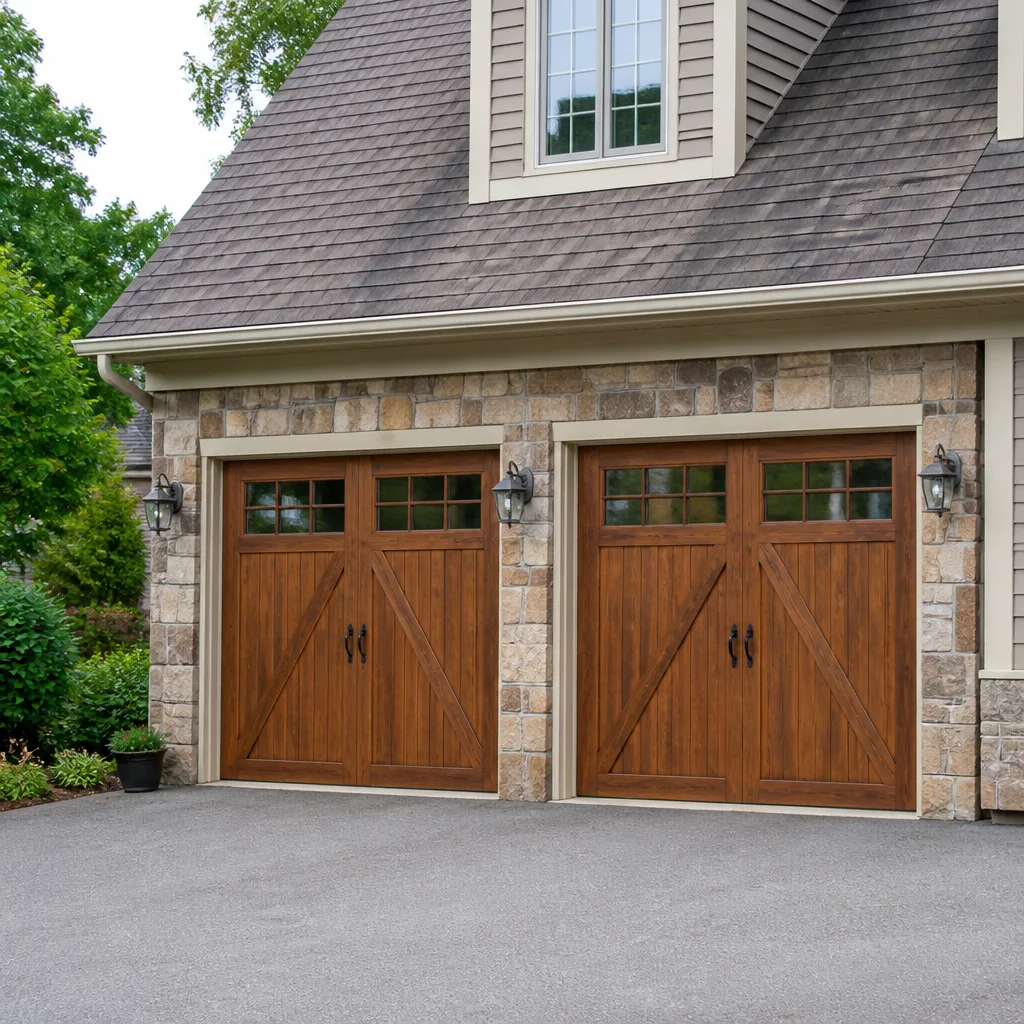 Carriage house
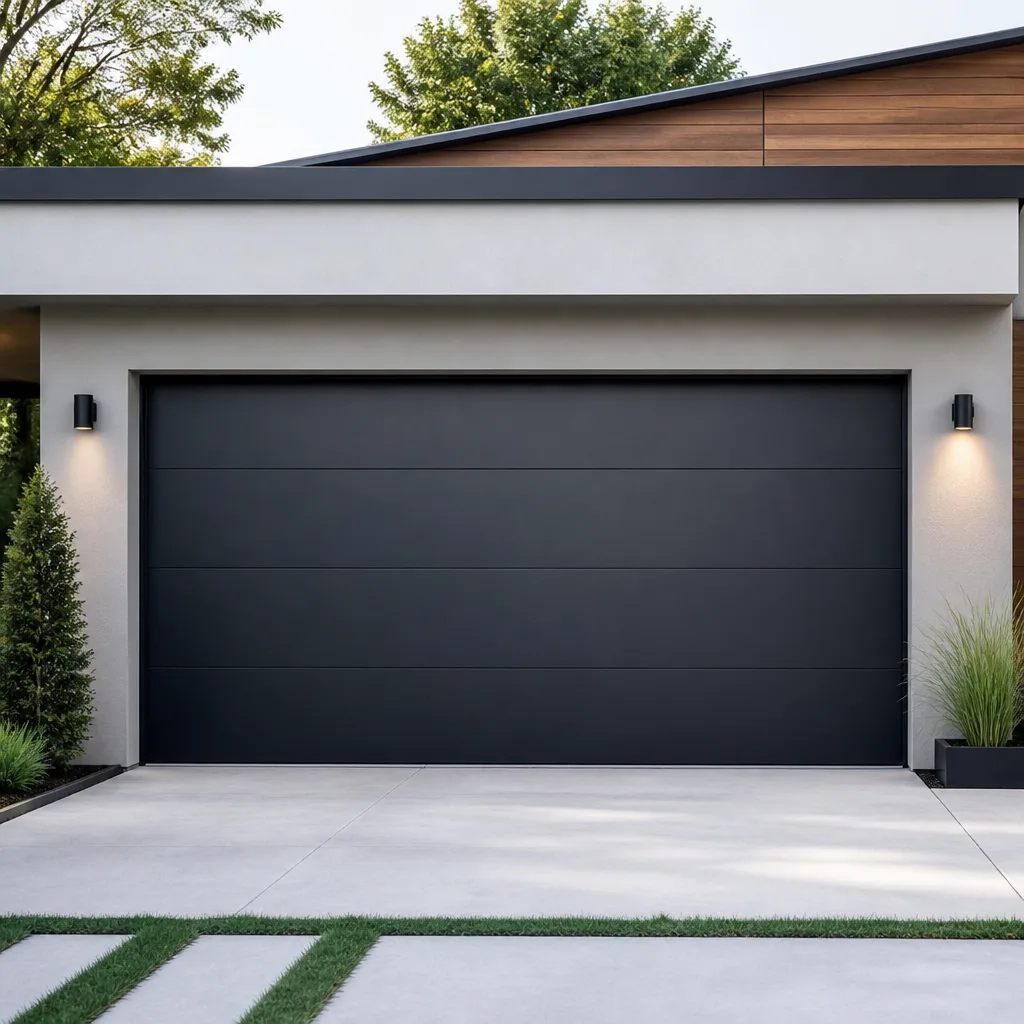 Modern flush
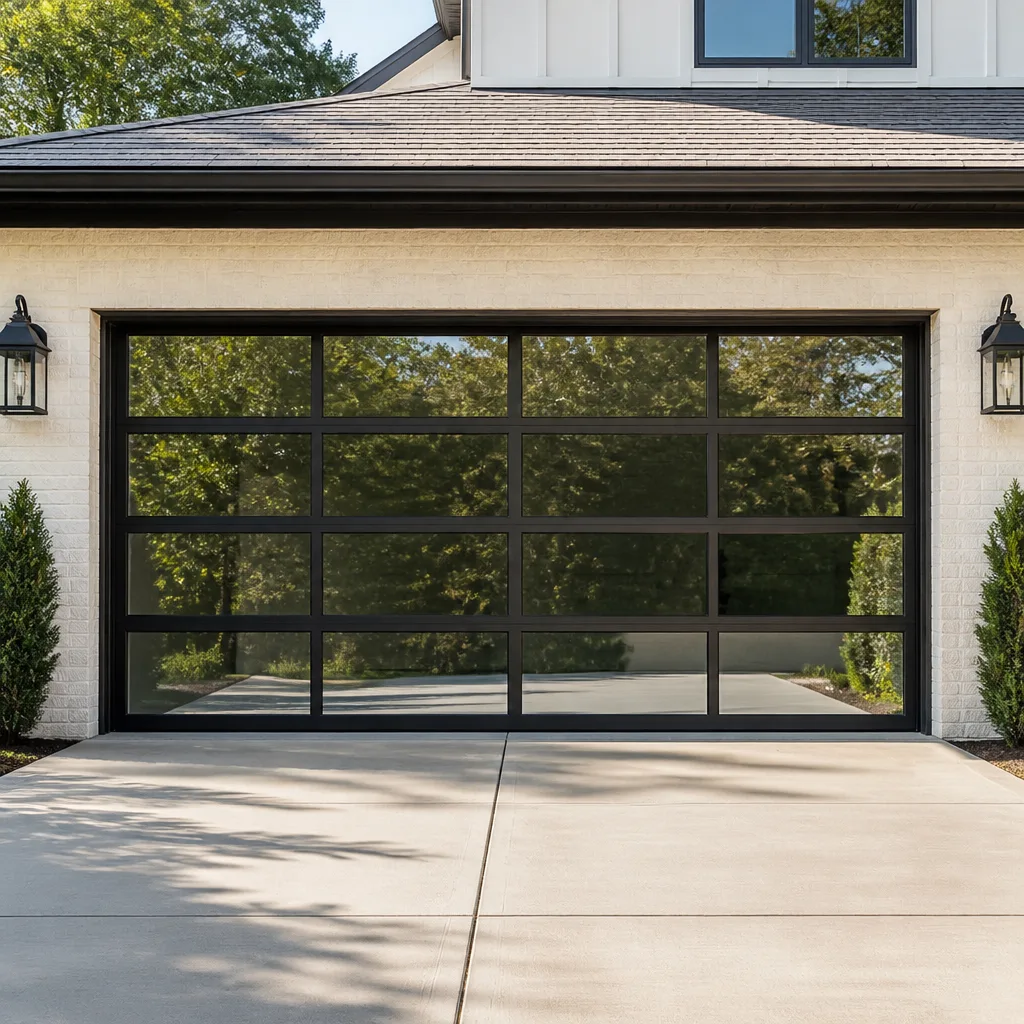 Full-view glass
 LiftMaster openers
 Chamberlain openers
Full 25-point door and opener safety check with every visit - springs, cables, rollers, tracks, and your LiftMaster or Chamberlain opener included
You get a price before we start. It does not change when the truck arrives.
Get your free estimateSeasonal Garage Door Care for Ventura: Year-Round Homeowner’s Guide
Most seasonal garage door guides are written for places where winter means ice and snow. Ventura doesn’t have that problem, which is exactly why so many homeowners here skip garage door maintenance entirely. But the Sundowner winds that push fall temperatures above 100°F, the marine layer that sits on coastal neighborhoods from March through June, and the salt air that drifts in from the Pacific all create a wear pattern on garage door hardware that’s specific to this stretch of the California coast. This guide walks you through what Ventura’s actual weather does to your garage door across twelve months, what to check each season, and what you can safely handle yourself versus what needs a trained technician. We’ve repaired garage doors in Ventura since 2001, and the doors that fail are rarely the ones that get ten minutes of attention three or four times a year.
Quick Answer
Seasonal garage door care in Ventura means checking four things on a simple quarterly schedule: hardware oxidation from marine layer humidity in spring, UV damage to weatherstripping in summer, sensor alignment after fall Sundowner winds, and limit switch drift during winter temperature swings. Homes within one mile of the coastline need to double that cadence because salt air corrodes metal components roughly twice as fast. The whole routine takes under an hour per season and prevents most of the failures we see on service calls. For more guides & resources on keeping your door running smoothly, browse our blog.
Styles & brands we work with
Table of Contents
- Spring (March – May): Marine Layer Oxidation Assessment
- Summer (June – August): UV Damage and Weatherstripping
- Fall (September – November): Sundowner Wind Season
- Winter (December – February): Limit Switch Drift
- Year-Round Salt-Air Protocol for Coastal Homes
- The 30-Minute Quarterly Maintenance Routine
- Common Mistakes to Avoid
- When to Call a Professional
- Frequently Asked Questions
Spring (March – May): Marine Layer Oxidation Assessment
Spring in Ventura means exactly one thing for your garage door hardware: moisture. The marine layer that rolls in off the Pacific and lingers through May keeps relative humidity high even when the temperatures feel mild. That humidity settles on bare metal components, and once oxidation starts on a torsion spring, the coil mounted above the door that does most of the lifting, it doesn’t stop on its own. By the time you see rust, the metal underneath has already been compromised.
Here’s what we check on our own trucks’ service area when spring rolls around, and what you can check on yours:
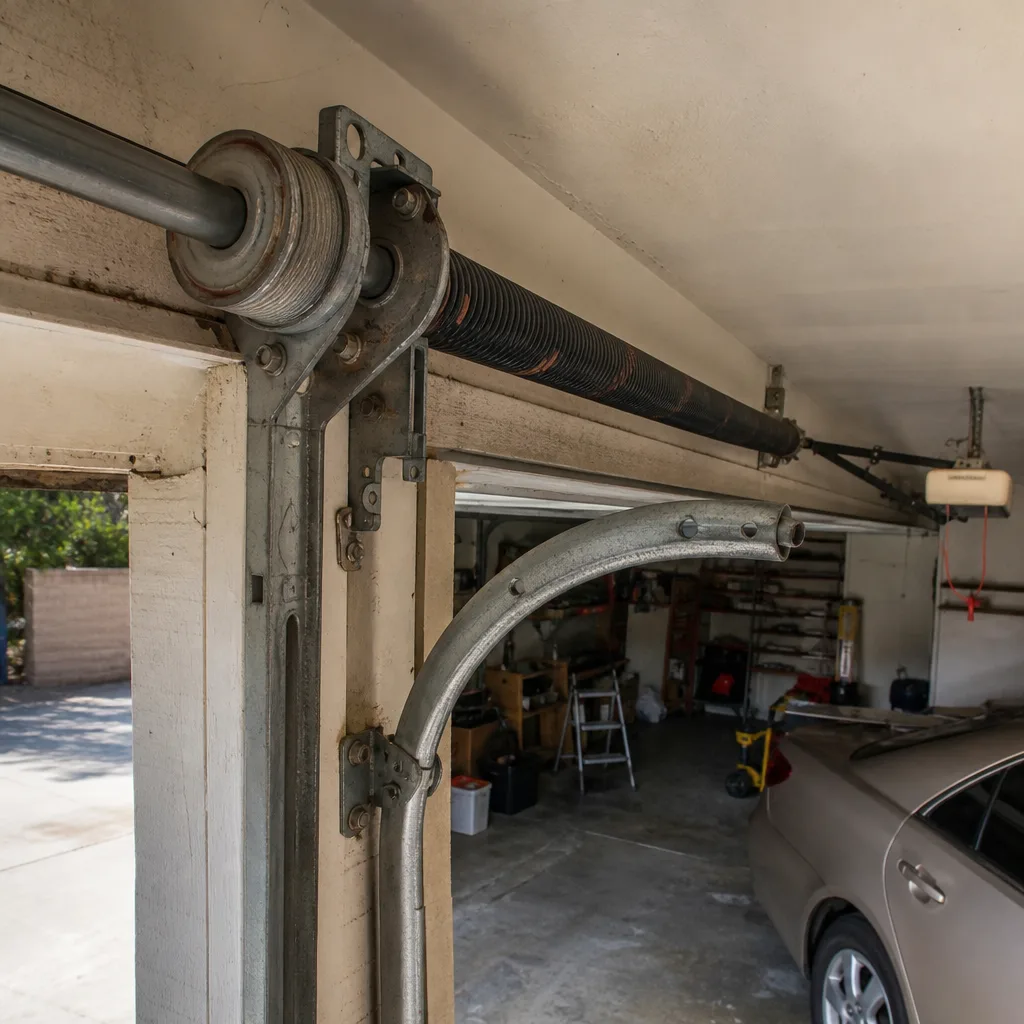
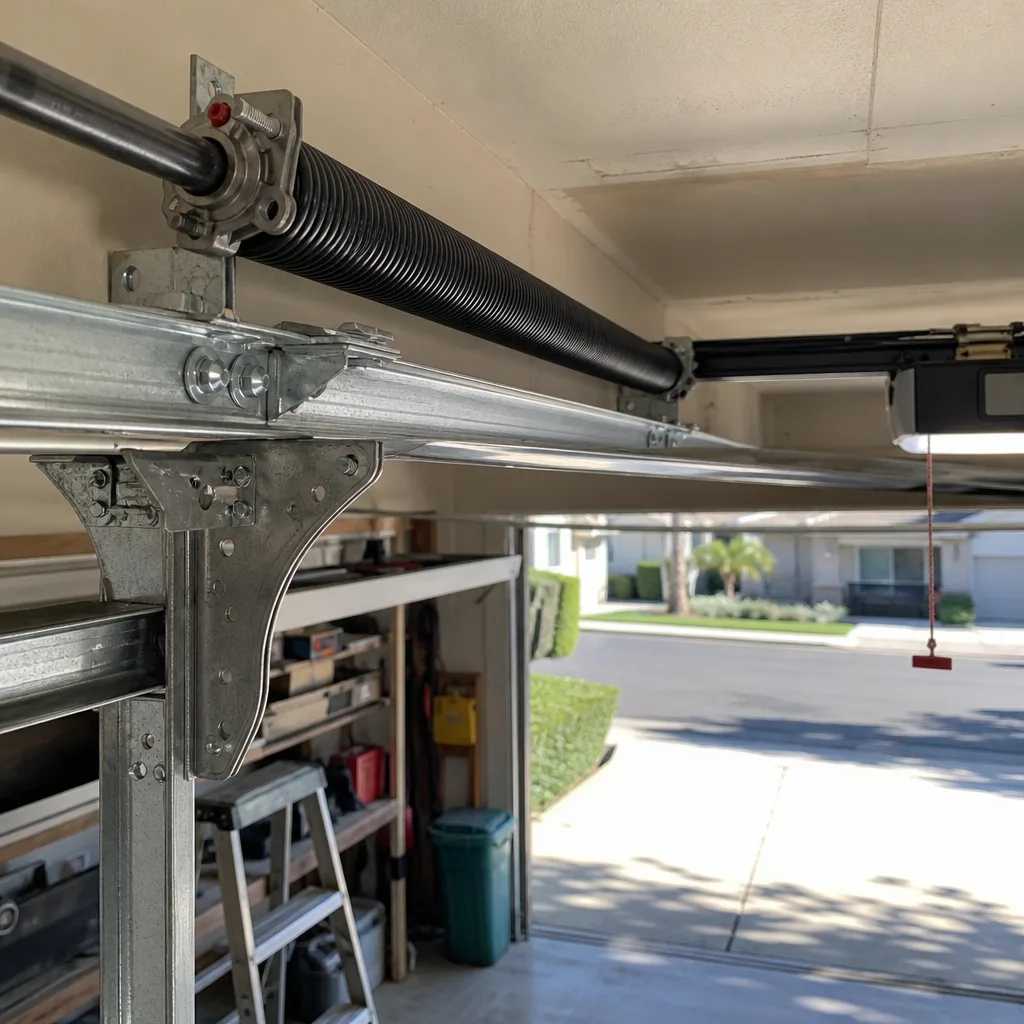
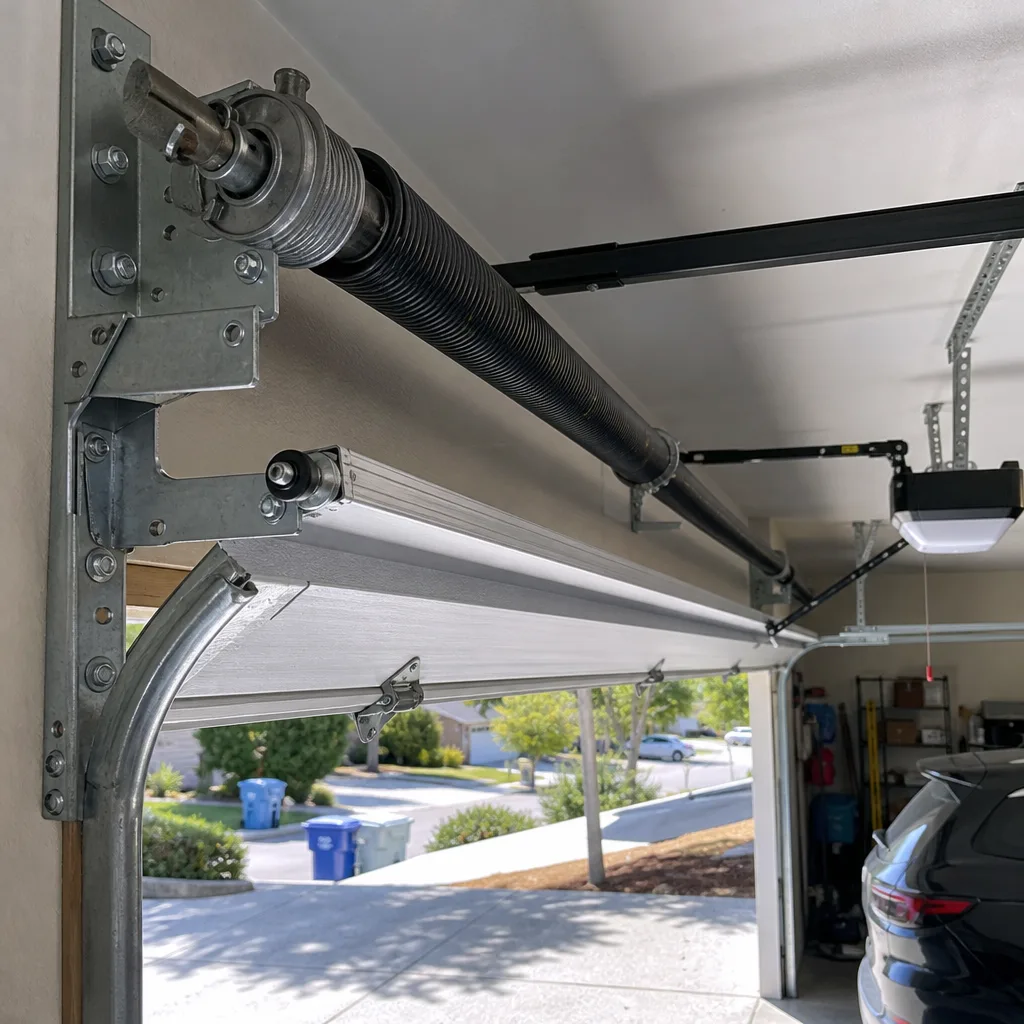
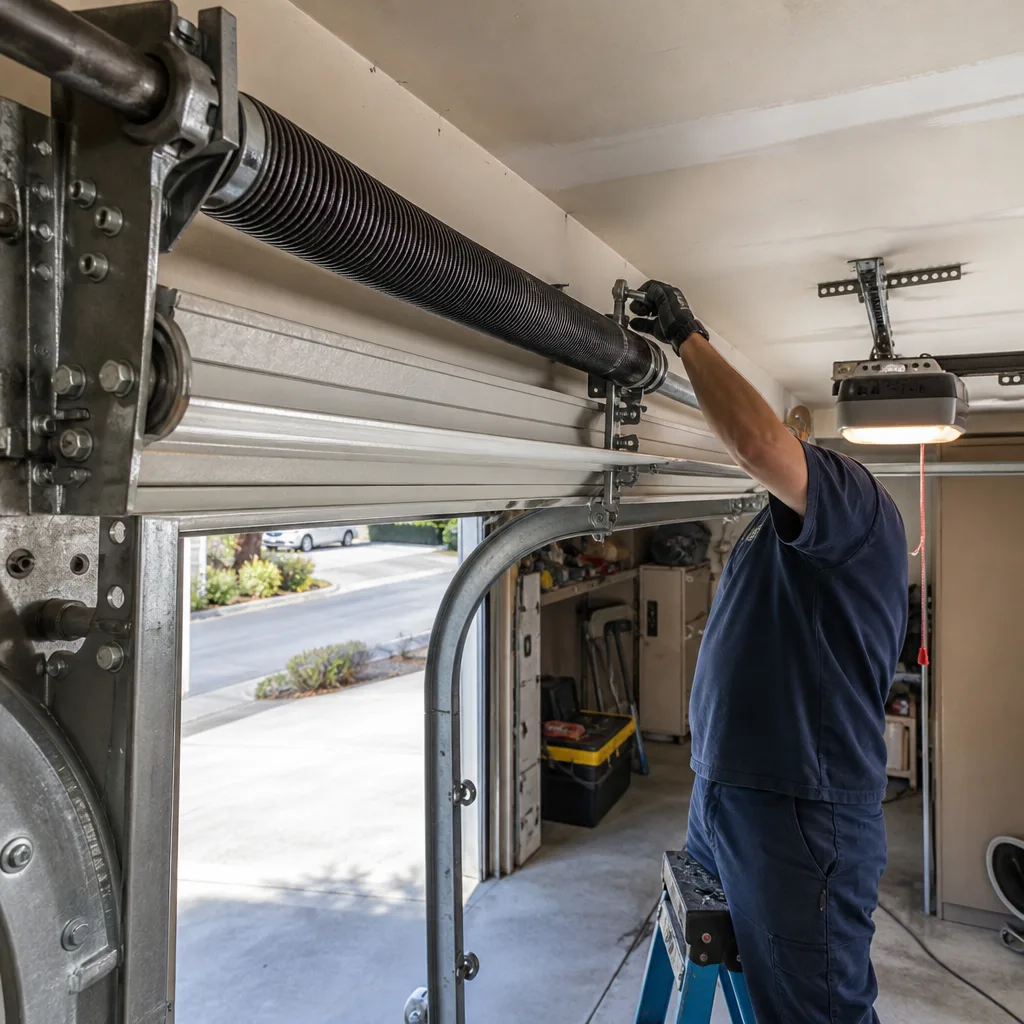
- Inspect the torsion spring for surface rust. Look at the coil above the closed door. If you see reddish-brown discoloration or flaking, that spring is weakening. A spring with visible oxidation is a candidate for replacement, not repair. Do not touch or attempt to adjust a torsion spring yourself. These springs are wound under enough tension to cause serious injury, and a trained technician has the proper winding bars and training to handle them safely.
- Check cable strands for fraying. The lift cables run along both sides of the door. Run your eye along the full length of each cable. If you see any individual wire strands separating from the main bundle, that cable is failing. Cable replacement is another job for a professional, because the cable works in tandem with the spring system.
- Wipe down all exposed metal hardware. Hinges, brackets, roller stems, and the track fasteners all collect moisture during marine layer season. A dry microfiber cloth is enough for surface-level cleanup. For light oxidation on non-spring hardware, a light application of white lithium grease on pivot points helps, but avoid spraying anything on the spring itself.
- Run the door through a full open-close cycle and listen. A door that squeaks, grinds, or shudders in early spring is telling you something about its balance. A properly balanced door should lift smoothly with minimal noise. If yours doesn’t, the spring tension may have shifted during winter, and the door needs a balance test and possible adjustment.
In our experience at Doyle Garage Doors Ventura, spring is when we replace the most rusted torsion springs in coastal Ventura neighborhoods. The marine layer sits on Midtown and the Avenues just as heavily as it does on the beach, and garage doors facing west collect the brunt of it. If you’re within a mile of the coast, the salt-air protocol in the section below applies to you year-round, not just in spring.
Summer (June – August): UV Damage and Weatherstripping
Ventura summers are famously mild, but the sun is still relentless. June through September brings clear skies and intense UV exposure, especially on south- and west-facing garage doors. The two components that suffer most are the bottom weatherstripping and the door panel finish, and both fail gradually enough that most homeowners don’t notice until the damage is done.
The bottom weatherstrip is the rubber or vinyl seal running along the lower edge of your door. Its job is to keep water, dust, leaves, and pests out of the garage. UV exposure breaks down the material at a molecular level. The strip gets brittle, develops cracks, and eventually loses its flexibility entirely. Once that happens, it no longer seals against the concrete floor. You’ll see daylight under the door, and after a rain you’ll find water pooling in the garage.
Here’s how to assess and address summer UV damage:
- Test the weatherstrip with a flashlight. Close the door at midday and crouch down at the bottom edge. Shine a flashlight toward the seal from inside the garage. If you can see light passing through, the seal has failed and needs replacement.
- Press the weatherstrip with your thumb. A healthy seal should flex and rebound. If it feels hard, crumbly, or leaves a dent, the material has degraded past its useful life.
- Check the panel finish on west-facing doors. Steel doors from brands like Raynor, Wayne Dalton, and Amarr are factory-finished with UV-resistant coatings, but those coatings have a lifespan. Fading is cosmetic. Peeling, chalking, or bare metal exposure is structural and needs attention before rust sets in.
- Inspect weatherstripping along the sides and top too. The vertical and header seals age at the same rate as the bottom strip. They’re often overlooked because they’re less visible, but they’re just as important for keeping heat and debris out.
If you replace your bottom weatherstrip once before it fails, you avoid the garage flooding and pest intrusion that a cracked seal invites. Most Ventura homeowners get three to five years from a bottom seal before the sun takes it, but a door that faces directly west toward the ocean may need replacement sooner depending on hours of direct daily sun exposure.
Fall (September – November): Sundowner Wind Season
Fall is the season when Ventura gets genuinely uncomfortable, and it’s the season most garage door guides completely miss. Sundowner winds are a local phenomenon: hot, dry downslope winds that sweep through the Ventura County valleys and coastal plain, most commonly between September and November. They routinely push temperatures past 100°F, even at the beach, and they gust hard enough to move an unsecured garage door.
Here’s what Sundowner season means for your garage door and what to check:
- Verify safety sensor alignment. The safety sensors are the two small units mounted near the floor on either side of the door opening, one sending an infrared beam and the other receiving it. Strong wind gusts can rattle the door, the tracks, and the wall mountings enough to knock these sensors out of alignment by a few millimeters. When that happens, the door will refuse to close, or it will reverse partway down as if it detected an obstruction. A misaligned sensor is a simple fix: check that both sensors are level and facing each other directly. Most sensors have indicator lights, and a solid light on each unit means they’re aligned.
- Check that all track fasteners are snug. Wind pressure pushes and pulls on the door panel, which transfers force to the tracks and mounting brackets. Walk both vertical and horizontal track sections and look for any gap between the bracket and the wall. If a bracket has worked loose, the door will operate noisily and unevenly. Tightening a few lag bolts is straightforward, but if a bracket has pulled away from the wall entirely, call a professional before running the door.
- Listen for a loud popping sound when the door moves. High heat causes the metal in a torsion spring to expand slightly. When the door operates and the spring flexes, a weakened section can release suddenly. A single pop is often the first warning sign of an imminent spring failure. Spring replacement typically costs $180 to $340 in Ventura for a standard single-door torsion spring installed, and it’s a repair you want done proactively rather than after the spring snaps and the door slams down.
- Check your opener’s heat dissipation. Garage door openers with DC motors run cooler than older AC models, but they still generate heat. On a 100°F day with the garage door closed, the opener’s circuit board can push past its rated operating temperature. If your opener hesitates, runs slower than usual, or stops responding briefly during a heat event, the circuit board may be overheating. Ventilating the garage and avoiding running the door unnecessarily during peak heat reduces the strain. Openers that fail this way typically need a logic board replacement, which we cover in detail on our garage door opener repair in Ventura page.
After a significant wind event, we recommend running the door through two full open-close cycles and watching for any hesitation, uneven movement, or unusual noise. Most wind-related issues are minor if caught early. They become expensive when ignored.
Winter (December – February): Limit Switch Drift
Ventura winters are gentle compared to most of the country, but the temperature swing between a summer heat wave and a January night is still enough to affect your garage door opener’s limit switch settings. The limit switch is the component inside the opener that tells the motor where to stop on the way up and where to stop on the way down. These settings are typically adjusted once at installation, and then forgotten.
Here’s the issue: temperature changes cause metal components, including the door itself, the tracks, and the internal opener mechanisms, to expand and contract minutely. Over months of summer heat followed by winter cold, those tiny shifts accumulate. The limit switch settings that were perfect in August may no longer be ideal in January. You’ll notice one of two symptoms:
- The door doesn’t close all the way. It stops an inch or two above the floor, leaving a visible gap. This happens when the down limit has drifted short.
- The door closes and then immediately reverses. The door hits the floor, the opener senses resistance it shouldn’t be experiencing, and the safety mechanism kicks in to reopen the door. This happens when the down limit has drifted long.
Adjusting limit switch settings is a straightforward process on most openers, but each model hides the adjustment mechanism differently, usually behind the light cover on the motor unit. You can find the procedure in your opener’s manual. I want to be candid here: if you’re not comfortable working with electrical components, or if you adjust the limit and the door still doesn’t close properly, don’t keep experimenting. Call a technician. A door that doesn’t seal properly is an open invitation to pests and worse, and a door that reverses unpredictably is a hazard for anyone underneath it.
In our experience, limit switch drift is one of the most common winter service calls in Ventura, especially on openers older than eight or ten years. Craftsman and older LiftMaster models are particularly susceptible because their limit switches are mechanical rather than digital. Newer openers with electronic limit settings drift less, but they can still be affected by extreme temperature swings.
Year-Round Salt-Air Protocol for Coastal Homes
If you live within one mile of the Ventura coastline, whether that’s Pierpont, the Keys, the Avenues near the beach, or Ventura Harbor, your garage door hardware is aging faster than the same door would two miles inland. Salt air accelerates corrosion measurably. We see garage door springs in coastal neighborhoods that show significant oxidation after three or four years, while identical springs in East Ventura or Saticoy look nearly new at the same age.
Here’s the year-round protocol we recommend for coastal Ventura homes:
- Monthly hardware inspection. Once a month, take five minutes and look at your torsion spring, cables, hinges, and track fasteners. You’re looking for any new rust spotting, any white powdery corrosion on aluminum components, and any change in the surface condition of metal parts.
- Quarterly lubrication. Apply white lithium grease to the roller stems, hinge pivot points, and the opener rail chain or screw drive. Wipe off any excess. Lubrication creates a barrier that slows salt-air corrosion on moving parts. Avoid applying grease to the torsion spring itself, as this can trap moisture against the metal and accelerate the very problem you’re trying to prevent.
- Rinse the lower door panel after heavy fog events. Marine layer fog carries salt. If you’re near the coast and the fog sits heavy for several days, a quick rinse of the lower two feet of your door with fresh water helps remove salt residue that would otherwise sit on the metal and paint.
- Inspect cables twice as often as inland homes. Lift cables are steel wire, and salt air attacks the thin strands relentlessly. What might be a cosmetic issue at six months becomes a structural failure at two years near the coast. Check for broken strands monthly.
- Budget for earlier spring replacement. A torsion spring that might last eight to ten years inland may only last six to eight in Pierpont or the Keys. Plan for that replacement in your home maintenance budget so the expense doesn’t blindside you.
The good news is that early detection makes nearly every coastal garage door issue affordable to fix. The bad news is that coastal homeowners who skip the protocol end up paying for full replacements rather than repairs. A rusted spring replacement costs the same whether you catch it early or late, but a snapped spring that damages the door panel or bends the track turns a $200 repair into a $900 replacement. See our Garage Door Cost Breakdown: The Ventura Homeowner’s Reference for 2026 for typical pricing on common repairs.
The 30-Minute Quarterly Maintenance Routine
If you want to keep this simple, here’s the entire seasonal garage door care routine for Ventura distilled into a 30-minute checklist you can run through every three months. This is what we tell homeowners who call us for routine advice on our garage door repair in Ventura page, and it covers 90% of the preventable failures we see.
- Visual inspection of springs and cables. Two minutes. Look for rust on the torsion spring and any frayed strands on the cables. If you see either, that’s a service call, not a DIY fix.
- Weatherstripping check. Three minutes. Press the bottom seal with your thumb. It should flex and rebound. Check the side and top seals for cracks or gaps. Replace anything that’s brittle.
- Sensor alignment check. Two minutes. Look at the indicator lights on both safety sensor units. Two solid lights means they’re aligned. If one or both are blinking, they need realignment.
- Balance test. Five minutes. Pull the emergency release cord and manually lift the door halfway. A properly balanced door should stay in that position without support. If it falls closed or flies open, the spring tension is off and the door needs service.
- Lubrication. Five minutes. Apply white lithium grease to hinge pivot points, roller stems, and the opener rail. You’ll hear the difference in how quietly the door operates.
- Full open-close cycle. Five minutes. Run the door through two complete cycles and listen for grinding, scraping, popping, or hesitation. Any new noise means something has changed since the last check.
- Floor and track debris check. Three minutes. Clear leaves, sand, and debris from the bottom of the door opening and from the track path. Debris in the door’s path is a common cause of false sensor trips and premature weatherstrip wear.
- Limit switch verification. Five minutes. Close the door and check that it seals completely against the floor with no gap. Open it and make sure it stops at the correct height without overrunning. If either limit is off, refer to your opener manual or call for service.
That’s the entire routine-The Complete Guide to Garage Door in Ventura in a nutshell. Four times a year, thirty minutes each. The doors that stay quiet, seal properly, and last their full service life are almost always the ones whose owners run through something like this list on a regular schedule. The doors that fail catastrophically are the ones that never get looked at until something breaks.
Common Mistakes to Avoid
- Ignoring a door that’s still opening and closing. Most garage door problems announce themselves long before failure. A door that’s getting louder, moving slower, or hesitating is asking for attention. Waiting until it stops working entirely means paying for the repair instead of the preventive fix.
- Lubricating the torsion spring. People think grease on the spring prevents squeaking and rust. In reality, grease traps salt and moisture against the metal and accelerates corrosion. Leave the spring alone.
- Adjusting the torsion spring yourself. The torsion spring is wound under enough tension to cause serious injury or death if mishandled. This is not a YouTube tutorial situation. If the spring needs adjustment, that’s a professional job, period.
- Replacing weatherstripping only after it’s completely gone. By the time the bottom seal has fallen off, water and pests have already been getting in for months. Replace the strip when it shows the first signs of brittleness, not when it fails entirely.
- Painting over rust instead of treating it. A quick coat of paint over a rusty spring hides the problem for a few months, but the spring is still weakening underneath. Surface rust on a spring is a replacement indicator, not something to cover up.
- Skipping the balance test because the opener still works. A garage door opener is designed to assist the spring, not replace it. If your spring has weakened and the opener is doing all the lifting, the opener’s motor is overworking and will burn out prematurely. The balance test catches this early.
- Assuming a mild climate means no maintenance. It doesn’t freeze here, so it’s easy to think the garage door needs nothing. Ventura’s climate has its own set of problems that are just as hard on hardware as any frost cycle, and we’ve covered them throughout this guide.
When to Call a Professional
Some garage door tasks are genuinely safe for a homeowner to handle. Replacing weatherstripping, lubricating pivot points, clearing debris, and checking sensor alignment all fall into that category. But several issues require a trained technician because the risk of injury is real and the margin for error is thin. If your torsion spring is rusted or your lift cables are frayed, call a professional. The stored tension in these components can release violently and without warning. If your door is off balance, if the opener’s circuit board is overheating, or if the limit switch keeps drifting after multiple adjustments, those are also professional jobs. Doyle Garage Doors Ventura offers free estimates in Ventura, and every repair comes with the 365-Day Done Right Promise: if the repair fails within a year of the service date, we come back and make it right at no charge. You’ll get a written price before any work starts, every time. Call (559) 239-8293 and a real person will answer, day or night, weekends and holidays included.
Frequently Asked Questions
Run through the 30-minute quarterly maintenance checklist four times a year, and double that to a monthly hardware inspection if you live within one mile of the coast. Full professional service, including spring tension adjustment, balance testing, and complete component inspection, is recommended every two to three years for most Ventura homes, and annually for coastal homes. Call (559) 239-8293 to schedule a professional inspection, and know that the price is always in writing before any work begins.
A professional garage door tune-up and inspection in Ventura typically ranges from $85 to $150 depending on the door type and condition, and includes balance testing, lubrication, sensor alignment, and a full hardware inspection. If the inspection uncovers a needed repair like spring replacement ($180 to $340) or cable replacement ($150 to $250), those are quoted separately and in writing before any work starts.
Yes, and measurably so. Homes within one mile of the Ventura coastline experience corrosion rates roughly twice as fast as homes two or more miles inland. We’ve replaced three-to-four-year-old springs in Pierpont that looked worse than eight-year-old springs in East Ventura. The salt-air protocol in this guide is designed specifically for coastal homeowners.
No. Torsion springs are wound under enough tension to cause serious injury or death if mishandled, and they require specialized winding bars and training to adjust safely. We never recommend DIY spring work. If your spring needs adjustment or replacement, call a professional. Our garage door repair in Ventura team handles spring work every day, and every repair carries our 365-Day Done Right Promise in writing.
A quality garage door opener typically lasts 10 to 15 years in Ventura, with one caveat: Sundowner heat events can shorten the lifespan of the logic board, especially in garages that lack ventilation. We’ve replaced circuit boards in openers that were only five or six years old when the garage regularly exceeded 110°F during fall wind events. If your opener fails during or immediately after a heat event, the circuit board is the likely culprit.
Broken torsion spring replacement is the repair we do most often in Ventura, year after year. It’s also the most preventable. Rust from marine layer humidity and salt air weakens the spring until it snaps under normal use. The balance test in our quarterly checklist is the single best early-warning indicator of a spring that’s nearing the end of its service life. Spring replacement is a same-day repair for us: call (559) 239-8293 and we’ll get you back up and running.
That depends on the door’s age, condition, and whether you’re planning to stay in the home. If your door is over 15 years old and needs both spring and panel work, replacement is often the better long-term value. If the door is structurally sound and only needs hardware repair, a repair is almost always more cost-effective. We’re happy to walk through the numbers either way in person during a free estimate. For more detail on what’s involved, see our garage door installation in Ventura page.
The Bottom Line
Your garage door is the largest moving part in your home, and in Ventura it works harder than most people realize. Marine layer humidity, salt air, UV exposure, and Sundowner winds each attack the door in their own way, and the damage compounds when you ignore it. Thirty minutes every quarter, with a little extra attention for coastal homes, prevents most of the failures we repair week after week. When you do need professional help, you deserve a company that tells you exactly who’s coming to your door, puts the price in writing before any work starts, and backs every repair with a written 365-day guarantee. We’re that company. Whether you need a spring replaced or you just want a thorough inspection, call (559) 239-8293 and we’ll take it from there. Learn more about who we are on our Doyle Garage Doors Ventura home page.
Written by Aaron Teague, Owner at Doyle Garage Doors Ventura, serving Ventura since 2001.
See the difference
 Before
 After
After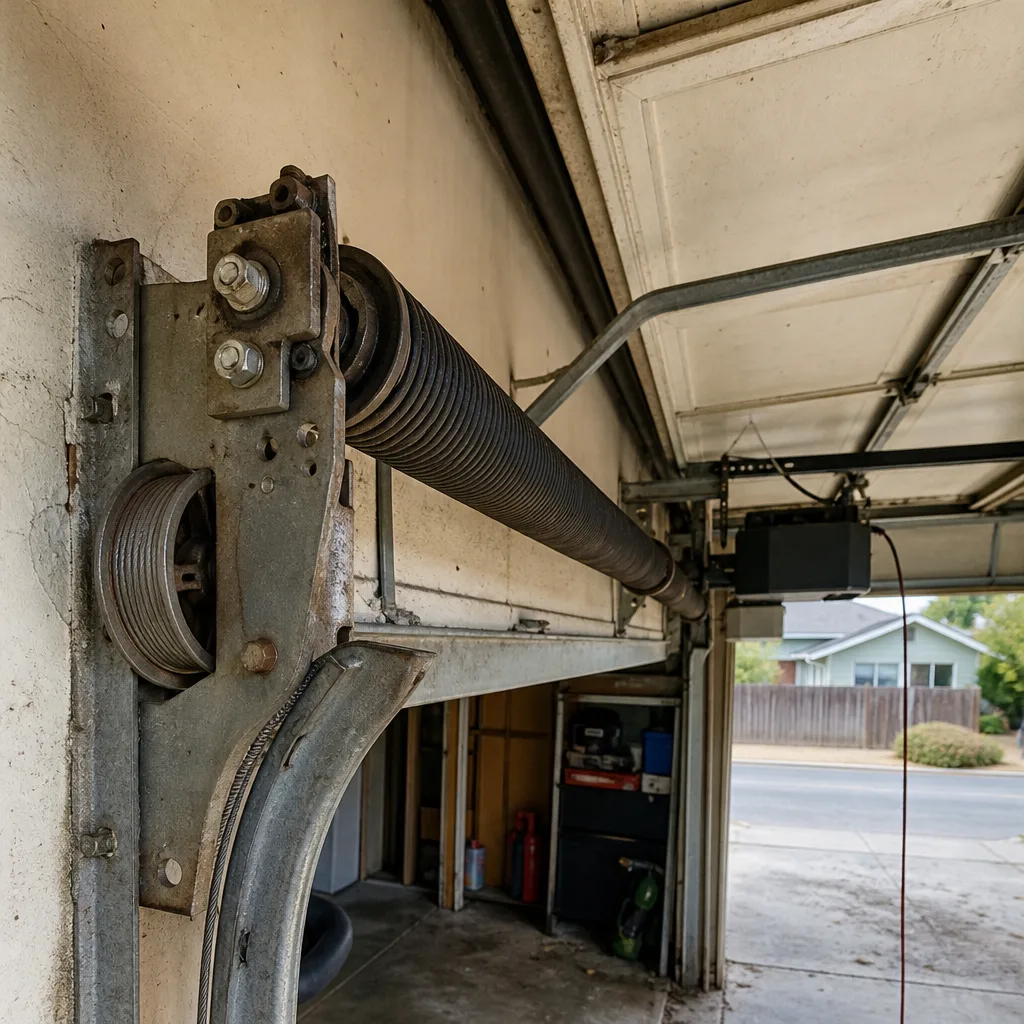 Before
 After
After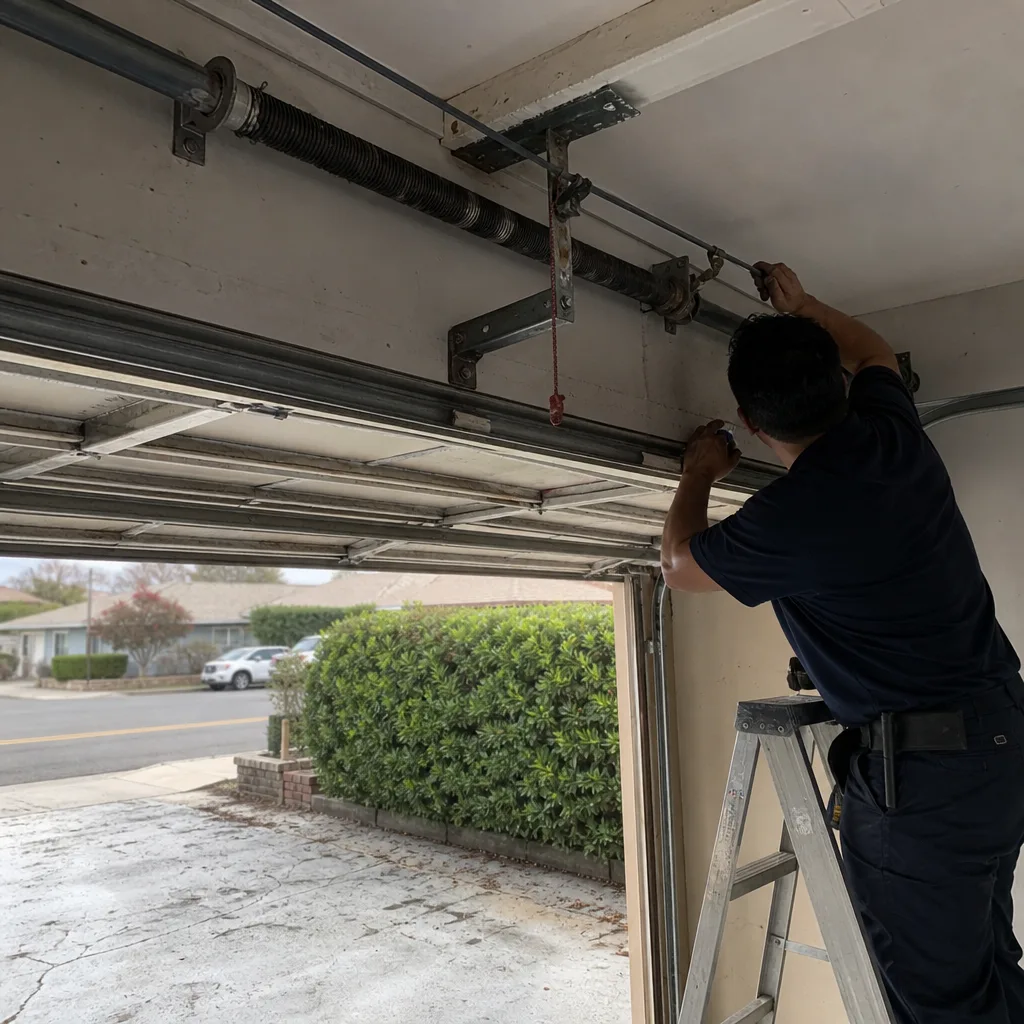 Before
 After
After